Local History · 8 min read · September 21, 2026 · By Clayton Hartford
What drew Henry Ford to Walkerville
In 1904, Canada's first Ford cars were built in a wagon factory in Walkerville, across the river from Detroit. That decision created the Ford Motor Company of Canada, gave its name to the town of Ford City next door, and set up the relationship between two neighbourhoods that still sit side by side on Windsor's east side today.
The short version
The Ford Motor Company of Canada was founded on August 17, 1904 in Walkerville, Ontario, by Gordon McGregor of the Walkerville Wagon Works, under an agreement with Henry Ford. Its first car, a Ford Model C, was built that fall. The company's growth east along the river built Ford City, which merged with Walkerville and Windsor in 1935.
A wagon maker with an idea
The story does not really start with Henry Ford. It starts with Gordon McGregor, a Windsor-born businessman who ran the Walkerville Wagon Works, the carriage and wagon factory his father William had headed. Gordon took over management in 1901 and became president in 1903.
Across the river, Detroit was filling up with people who believed the automobile would replace the horse. McGregor could see it from his factory floor. At a family meeting in January 1904 he put it to his brothers plainly: if men in Detroit were saying every farmer would soon own an automobile, why couldn't they build them right there in the wagon factory?
He took the idea to Henry Ford, whose Ford Motor Company was barely a year old. The two reached a personal agreement that let McGregor form and finance a company to build and sell Ford cars in Canada. On August 17, 1904, the Ford Motor Company of Canada was incorporated in Walkerville. Twelve Canadian shareholders held a controlling 51% of the shares; Henry Ford personally held 13%.
What drew Ford to Walkerville
Henry Ford did not go looking for Walkerville. Walkerville, through McGregor, came to him. But the location made the deal easy to say yes to, for four reasons.
- Detroit was right there. Walkerville sits on the south bank of the Detroit River, directly across from Detroit. In the early years parts were built in Detroit and ferried across the river by the wagonload to be assembled in the Walkerville factory.
- The tariff wall. Canada charged a 35 per cent tariff on cars imported into the country under the National Policy. Building in Canada meant Canadian buyers paid Canadian prices, not American prices plus a third.
- The British Empire. As part of the Empire, Canadian-made goods could be shipped to other Empire countries at lower tariff rates than American goods. McGregor's agreement gave Ford of Canada the right to sell Ford cars across the British Empire, excluding the British Isles. That is how Walkerville-built Fords came to be sold in India, South Africa, Australia and New Zealand; the company's first export sales went to Calcutta.
- A factory and a company town, ready to go. Walkerville was already a working industrial town, built by distiller Hiram Walker around his riverfront distillery. McGregor did not need to build anything to start. He had a factory, workers who knew how to build vehicles, and the river on his doorstep.
The first Canadian Ford
The first car built at the Walkerville Wagon Works was a Ford Model C, which rolled out in the fall of 1904. Twenty-five were finished by the end of that year, and 117 in the company's first full fiscal year. By 1922, the year McGregor died, Ford of Canada was building more than 51,000 vehicles a year and held roughly 70 per cent of the Canadian car market.
"There are men in Detroit who say every farmer will soon be using an automobile. I don't see why we can not build them here in the wagon factory." — Gordon McGregor, January 1904
From Walkerville to Ford City
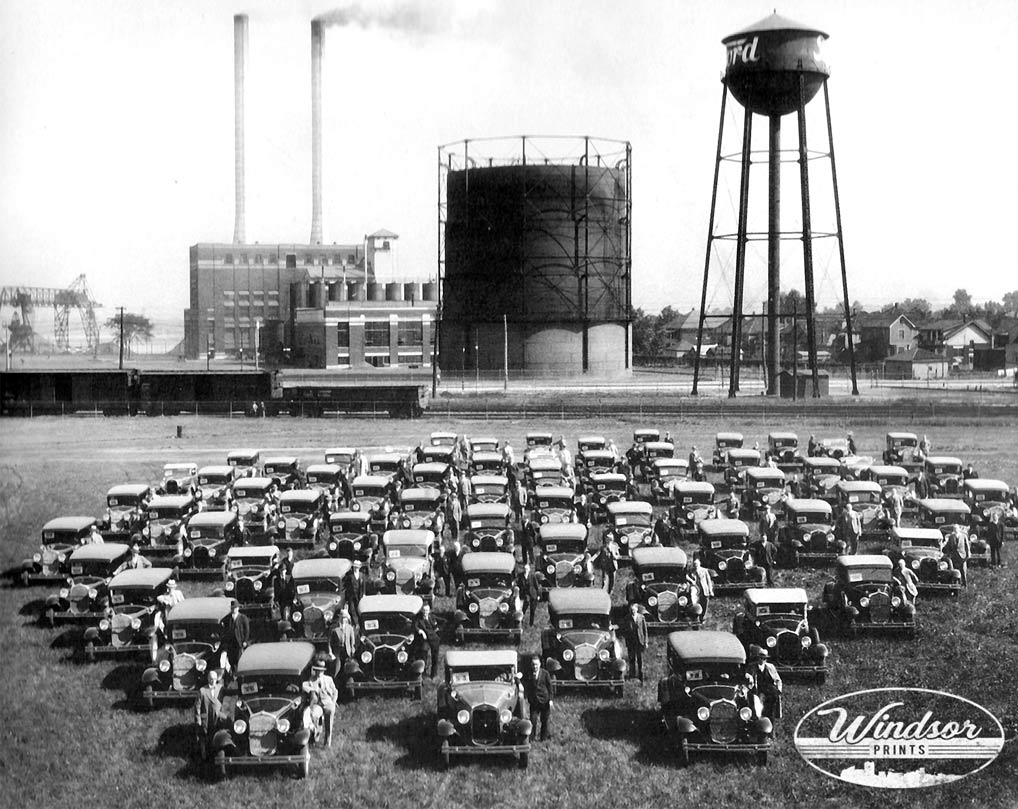
The wagon works could not hold that kind of growth. Ford expanded east along the river onto what had been sparse farmland, and between 1912 and 1914 built its landmark Plant 1 on the Detroit River at Riverside Drive and Drouillard Road, crowned with a rooftop FORD sign in fifteen-foot letters. At its peak the Ford operation there employed around 14,000 people.
A town grew up around the plant to house them. Ford City was incorporated as a village in 1913 and became a town soon after. It renamed itself East Windsor in 1928 and became a city in 1929. Then the Depression hit, and in 1935 East Windsor, Walkerville and Sandwich were all merged into the City of Windsor.
Ford City also made history of a different kind. The 99-day Ford strike of 1945 ended with the Rand Formula, the ruling on union dues that still shapes labour relations across Canada. Ford later moved its Canadian headquarters and main assembly to Oakville in 1953, and the old Plant 1 was demolished in the winter of 1969–70.
Two neighbourhoods, one story
Walkerville and Ford City grew up next to each other, but they grew up differently, and you can still see it.
| Walkerville | Ford City | |
|---|---|---|
| Built by | Hiram Walker and his distillery, from the 1850s | Ford Motor Company of Canada, from 1904 |
| How it grew | A planned company town: tree-lined streets, brick row houses and grand homes | Fast and unplanned, around a car plant and the workers it needed |
| Main street | Wyandotte Street East and the Distillery District | Drouillard Road |
| Character today | Heritage homes, restaurants and the distillery | Working-class roots, independent shops, and one of Windsor's best street festivals |
Walkerville was planned down to the street layout. Ford City was built in a hurry by people who came to work at the plant. Both were company towns, and both were folded into Windsor in the same year. The distillery and the car plant stood a short distance apart on the same stretch of riverfront, and the two neighbourhoods have been bound together ever since.
Ford City today: worth the trip down Drouillard
Ford City has been having a moment. Drouillard Road, the old main street, is now lined with independent restaurants, bars, cafes and shops, and it is an easy bike ride or a few minutes' drive from our houses in Walkerville.
- Block parties. The Ford City BIA throws Dropped on Drouillard every August: a street festival with live music, local artists, food trucks and every storefront open. Keep an eye on the Ford City events calendar for the flea market and smaller events through the year.
- Food, bars and coffee. Great restaurants, cool hipster bars and cafes line the strip: BBQ, burgers, Italian street food and a proper coffee stop.
- The bike shop. City Cyclery at 1008 Drouillard Road, if your ride needs attention (or if you've borrowed one of our cruiser bikes and want to see where the locals shop).
- The cookie shop. If you make it out there, check out Cookie Bar at 1093 Drouillard Road: fresh cookies and craft beer, which turns out to be a very good combination.
- The beer hall. Further down the road is one of our favourite summer patios: Heimat, Windsor's German club, at 1367 Drouillard Road. Its biergarten runs from April to October with German and Bavarian food and Paulaner on tap. We'll tell you more about their Oktoberfest in a separate post.
Common questions
When did Ford come to Canada?
The Ford Motor Company of Canada was founded on August 17, 1904, in Walkerville, Ontario, now part of Windsor.
Why did Ford build in Walkerville?
Gordon McGregor of the Walkerville Wagon Works proposed it to Henry Ford. Walkerville was directly across the river from Detroit, building in Canada avoided a 35 per cent tariff on imported cars, and Canadian-made cars could be exported across the British Empire at lower tariffs. McGregor also had a factory and a workforce ready to start.
What was the first car Ford built in Canada?
The Ford Model C, built at the Walkerville Wagon Works in the fall of 1904.
Is Ford City part of Walkerville?
No. They are neighbouring areas on Windsor's east side. Ford City grew up around the Ford plant east of Walkerville, was incorporated in 1913, and merged into Windsor along with Walkerville in 1935.
How far is Ford City from Walkerville?
Close. Drouillard Road is a short bike ride or a few minutes' drive east of the Walkerville Distillery District.
Stay in the neighbourhood that started it
Our heritage homes in Walkerville put you a short ride from Drouillard Road and a short walk from the distillery. See the houses or email hello@distilleryhomes.com.
Sources
- Ford Motor Company of Canada and Gordon Morton McGregor, Wikipedia
- Automotive Industry, The Canadian Encyclopedia
- Ford City, Ontario, Wikipedia
- The History of Ford City, Windsor Prints
- 1904: An International Milestone, Transportation History
Related: A history of Walkerville · Cruiser bike rentals · A weekend in Windsor